Who is it for?
An exercise stress test is generally used when blocked arteries are still suspected after an examination and initial tests.
The test is not suitable for everyone. It is not done in situations such as a recent heart attack, chest pain that continues at rest, uncontrolled high blood pressure or severe valve narrowing. Different tests are preferred for people with joint or balance problems that prevent walking and for those whose resting ECG makes the result difficult to interpret.
Its main uses are:
- Assessing chest pain or shortness of breath that comes on with exertion
- Investigating certain heart rhythm problems that appear during exercise
- Seeing how blood pressure responds to exertion
- Determining exercise capacity in people with known heart disease
How is the test done?
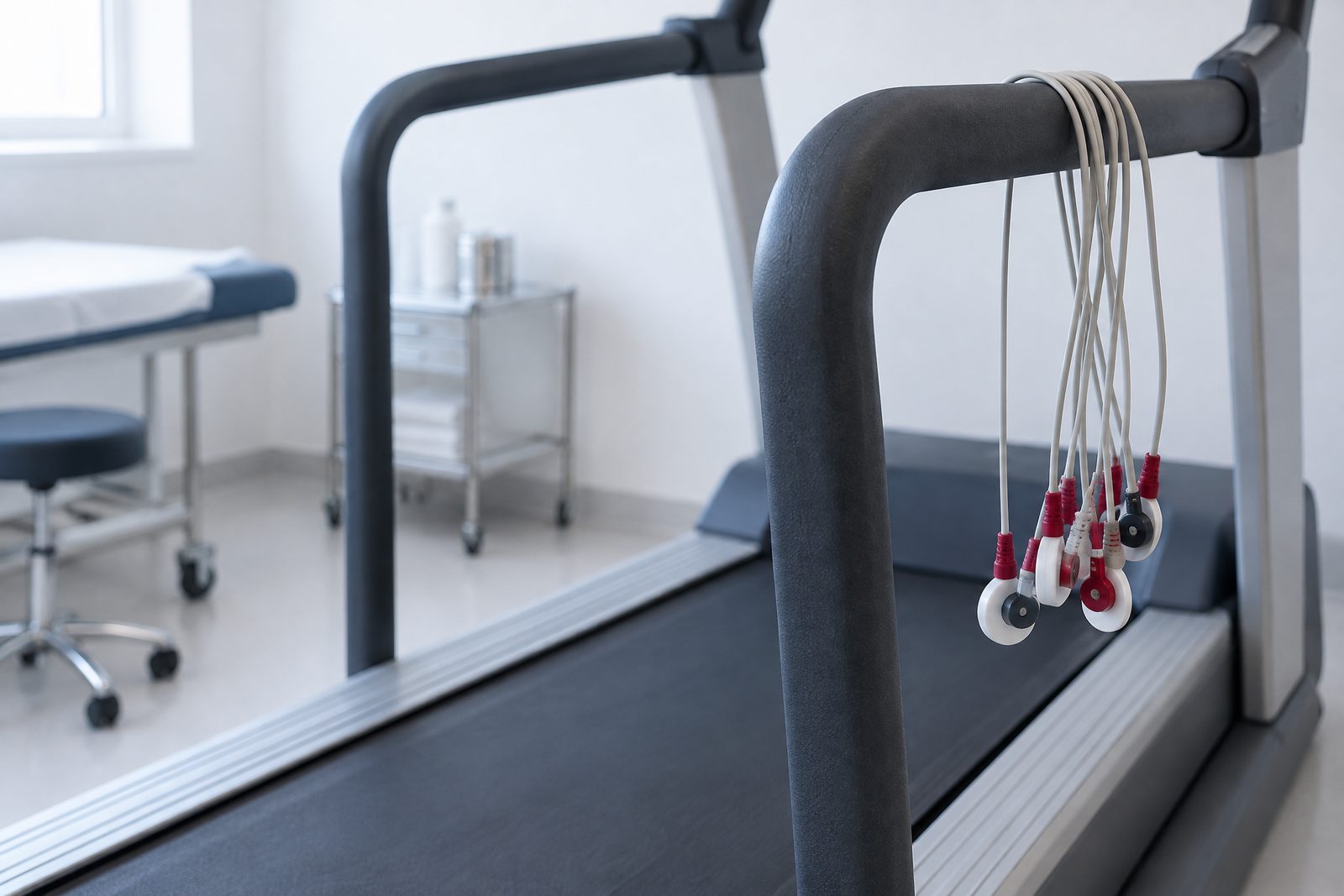
ECG electrodes are attached to your chest and a blood pressure cuff is put on your arm. You then start walking on a treadmill. The speed and slope of the treadmill are increased at set intervals. During this time your ECG is monitored continuously and your blood pressure is measured regularly.
The test ends when you reach the target heart rate for your age. It is stopped earlier if you have chest pain, marked shortness of breath, dizziness or extreme tiredness, or if there is a change on the ECG or an unexpected change in blood pressure. If you feel unwell in any way during the test, you need to say so straight away. Monitoring continues for a few more minutes after the walking ends.
A doctor or an experienced healthcare professional is with you throughout the test. You can rest your hands lightly on the handrails while walking on the treadmill, but you should not put your weight on them. Including preparation and rest time, the test usually takes about half an hour.
Preparing for the test
Good preparation helps the test go safely and also helps the result to be interpreted more reliably. Keep the following in mind:
- Eat a light meal a few hours before the test. Do not come hungry or very full.
- Do not smoke or drink tea or coffee in the hours before the test.
- Wear comfortable clothes and trainers.
- Tell your doctor about the medicines you take. Some medicines may need to be stopped before the test, but do not make this decision yourself.
- Do not put cream or lotion on your chest, as it makes it harder for the electrodes to stick.
- If you feel unwell or have a fever on the day, let the team know before the test.
What does the result mean?
The result is not interpreted from ECG changes alone. How long you were able to walk on the treadmill, how your heart rate and blood pressure responded to exertion, and whether you developed any symptoms during the test are also taken into account.
A positive test means that signs suggesting the heart is not getting enough blood were seen during exertion. This result alone does not amount to a definite diagnosis. Taking your symptoms and risk factors together, the doctor may request further tests such as coronary CT angiography or an angiogram.
A negative result shows that no such signs were found during the test. This is reassuring, but it does not completely rule out the possibility of artery disease. If your symptoms continue, you need to tell your doctor. If, outside the test, you have chest pain that does not go away at rest, call 112 (the emergency number in Türkiye) or your local emergency number.